
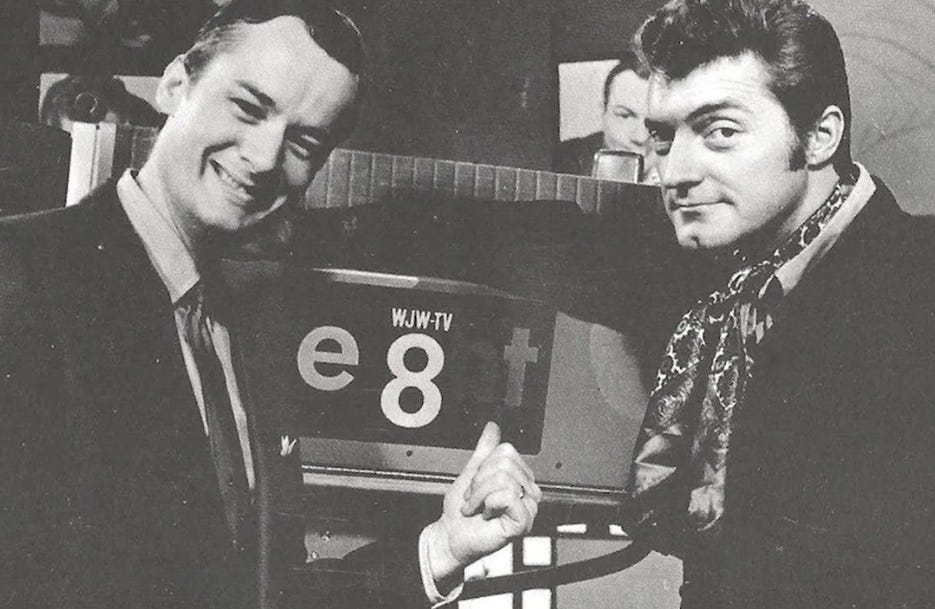
Hoolihan’s (i.e., Bob Wells’s) last night (August 31, 1979) before The Hoolihan and Big Chuck Show (1966-1979) became The Big Chuck & Lil’ John Show (1979-2007) includes classic sketches, the first a variation on the familiar comic book Charles Atlas bodybuilding ad.
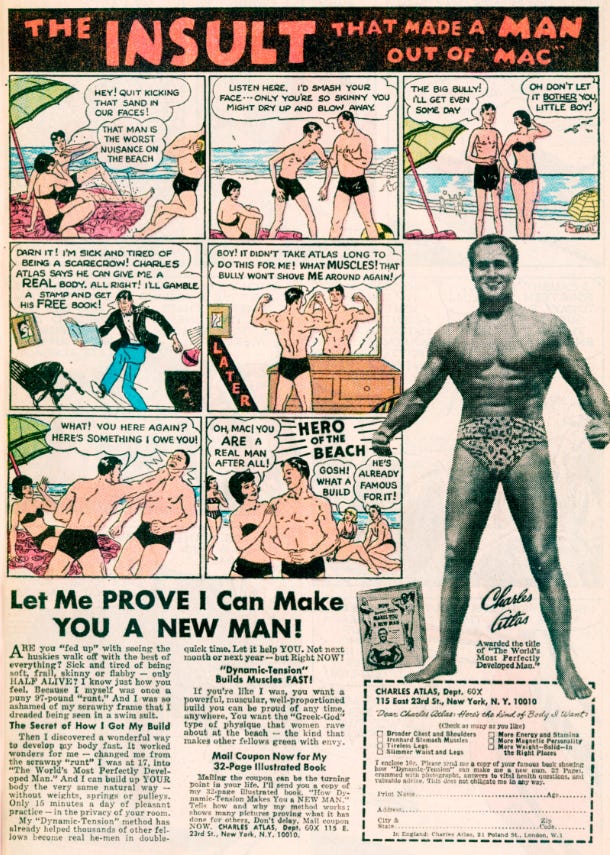
The Hoolihan and Chuck version has Hoolihan getting sand kicked in his face by bully Big Chuck. Cut to Hoolihan clipping a weight-lifting ad from a comic book and spending weeks lifting before coming back buff and beating the bully up.
When the bully Big Chuck beats up Hoolihan, the girl goes Darwinian, leaving her wimpy boyfriend for the bully. But when Hoolihan beats up the bully, the girl feels sympathy for the bully and, again, leaves with the bully.
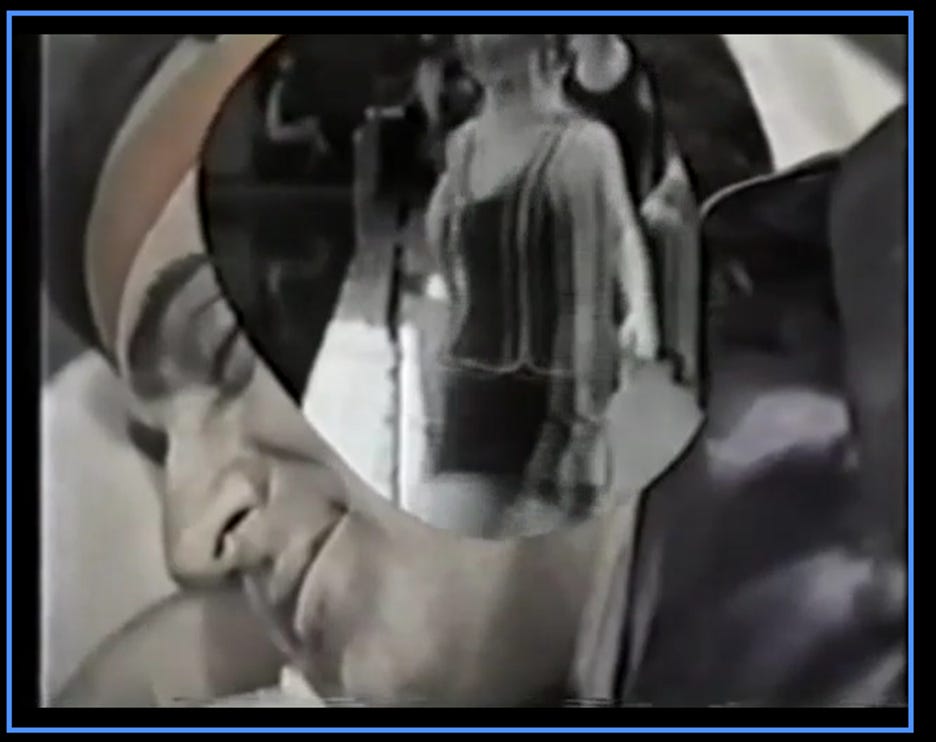
In another sketch, “The Kielbasa Kid,” The Kid’s trusty sidekick “Kishka” (Tony Carmen) dreams of bathing beauties
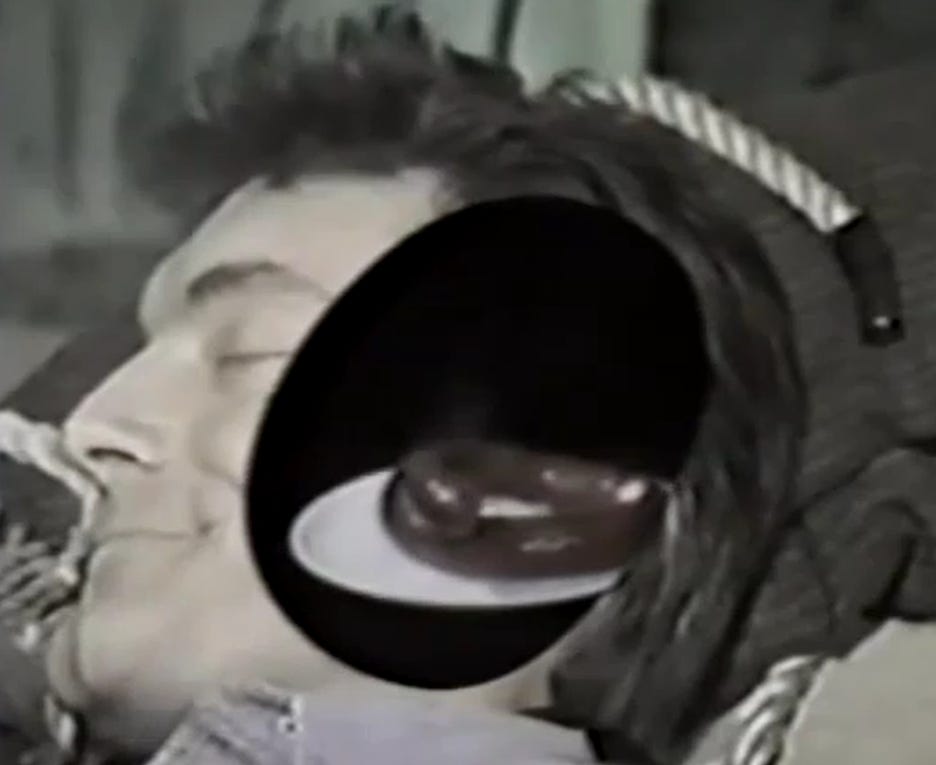
Meanwhile, The Kid dreams of a kielbasa, and “wonder dog” King dreams of a fire hydrant.
The film that played for Hoolihan’s send-off special was Return of the Fly (Edward Bernds, 1959), a more-than-adequate but initially chatty sequel to The Fly (Kurt Neumann, 1958) and a screening typical of the type of horror films recycled for WJW-TV Channel 8’s three big horror-sketch shows: Ghoulardi, The Hoolihan and Big Chuck Show, and The Big Chuck & Lil’ John Show—shows that, combined, ran for forty-four years.
As noted in the documentary Turn Blue: The Short Life of Ghoulardi (Phil Hoffman, 2009)—a film based on Ghoulardi: Inside Cleveland TV’s Wildest Ride (Tom Feran & R.D. Heldenfels, 1997) by Gray & Company Publishers—“the 1956 TV airing of the original King Kong [Merian C. Cooper & Ernest B. Schoedsack, 1933] drew 90% of the TV audience,” and shortly thereafter Columbia Studio’s Screen Gems released fifty-two vintage horror films into ninety U.S. markets.
Mark Dawidziak notes in Hoffman’s doc that Universal’s “Shock Theater,” a package for which Screen Gems had acquired syndication rights, introduced younger viewers to older movies and sent local affiliates searching for charismatic hosts to present these newly syndicated old horror films late at night, along with a daytime children’s market of resurrected comedy shorts like Our Gang (1922-1944), Laurel and Hardy (1927-1955), and The Three Stooges (1922-1970).
One of these regional hosts was Ghoulardi (Ernie Anderson), whose loose-goose beatnik antics ran three years (1963-1966) before Anderson went to L.A. for more lucrative voice work, including serving as the voice for The Love Boat (1977-1986).
After the anarchic talent Anderson went through various chaotic hirings and firings at other stations, Ghoulardi not only gave Anderson’s early career stability, but also launched the career of Tim Conway, of Willoughby, Ohio, who was poached by Rose Marie and Steve Allen. Anderson’s son is director Paul Thomas Anderson, whose production company bears the name of his father’s infamous Cleveland host persona. And, locally, the show launched the careers of Bob “Hoolihan” Wells and “Big Chuck” Schodowski, whose recurring characters over a forty-five year career in Cleveland media included Polish stereotype Stash Kowalski, The Kielbasa Kid, Ben Crazy, and various “Certain Ethic __________s,” which were “Polack jokes” put to short film.
“Once Philippe got very angry at me and threw sand in my face,” says Cecile (Danielle De Metz) in Return of the Fly, and one wonders at the happy coincidence of the film’s sand-in-face bullying reference following the rerun of Chuck and Hoolihan’s Charles Atlas sketch.
Filled with content notoriously corny—by which I mean both the show’s original sketches and many of the rerun films themselves—The Hoolihan and Big Chuck and Big Chuck & Lil’ John shows may seem incapable of so much foresight as to have a sketch thematically mirror a line from the film.
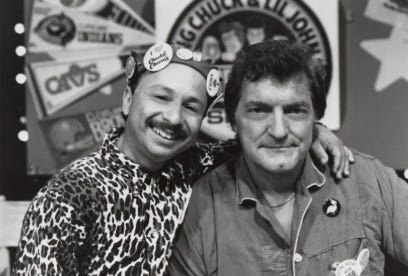
But the 1979 send-off for Bob Wells indeed chose a film that at least slightly mirrors the low-budget local affiliate’s interpolation thereof, insofar as the Fly sequel is preoccupied with the past, constantly referencing the desire of young mad scientist Philippe Delambre (Brett Halsey) to complete his father’s work in order to justify his father’s tragically mutated failure, while the variety show frame itself is also about legacy and reflection…
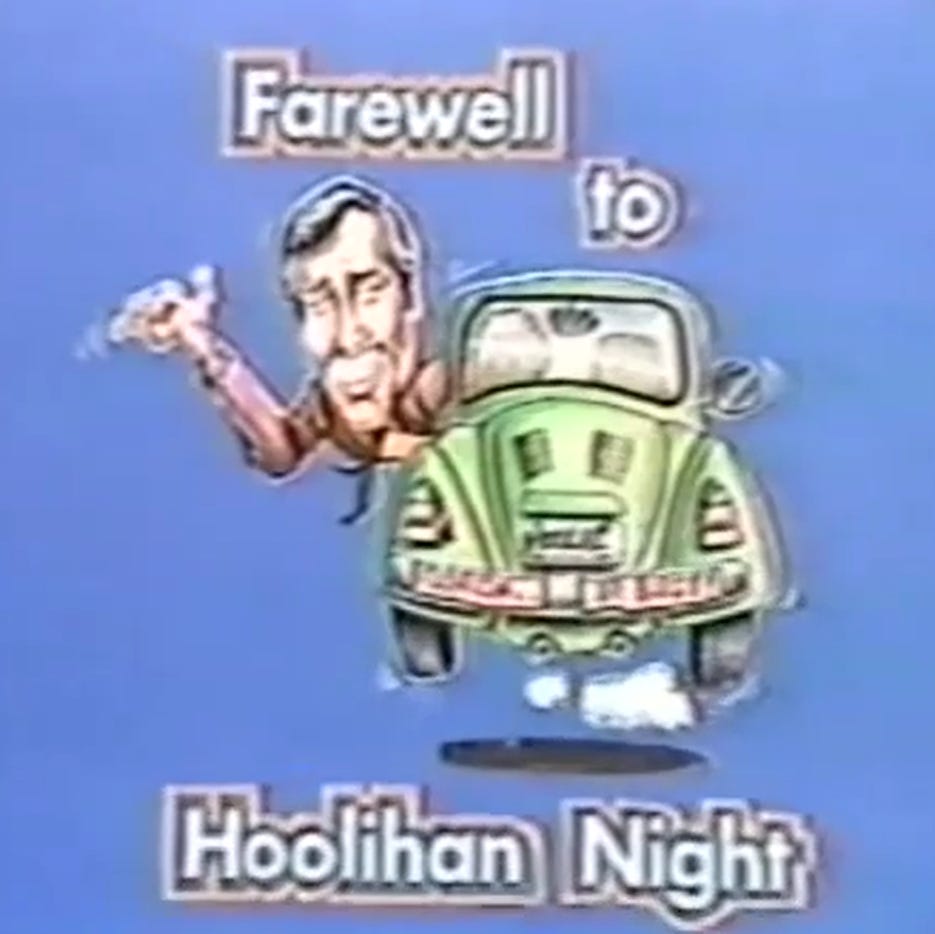
…with Hoolihan saying during a break, “we do hope you’re enjoying our bit of nostalgia; it’s kind of leaving me with the most bittersweet feeling I’ve ever had.”
Of course, the tonal disparity separating a B-horror film’s father-son theme of a tragic past and hosts Hoolihan’s and Chuck’s shifts from sincerely melancholic remembrance to absurd low-budget sketches is part of the reason no continuity between chosen film and comic breaks is ever really necessary on this late-night series. In fact, within the breaks, the music surrounding the hosts is constantly shifting mood as well, from Barbra Streisand’s “The Way We Were” (1973) to Stevie Wonder’s “Sir Duke” (1976).
Just as the point of Return of the Fly is not primarily a son’s doomed attempt to justify his scientific father’s madness, but rather to bring some pleasure to horror audiences, so too the point of Hoolihan and Big Chuck is ultimately less to be reflective about thirteen years of Hoolihan’s work in Cleveland than to put and keep Cleveland on the map in the minds of Clevelanders.
Hoolihan himself is clearly moved by the night’s significance, as is his co-host Big Chuck; nevertheless, Hoolihan misses no chance to brand the show by appreciating the series’s tendency to occasionally screen a film starring “a class act like Vincent Price”; and at one point in the night’s proceedings, the hosts give thanks to the many “real pros” who have joined them over the years, the implication being “class act” by association.
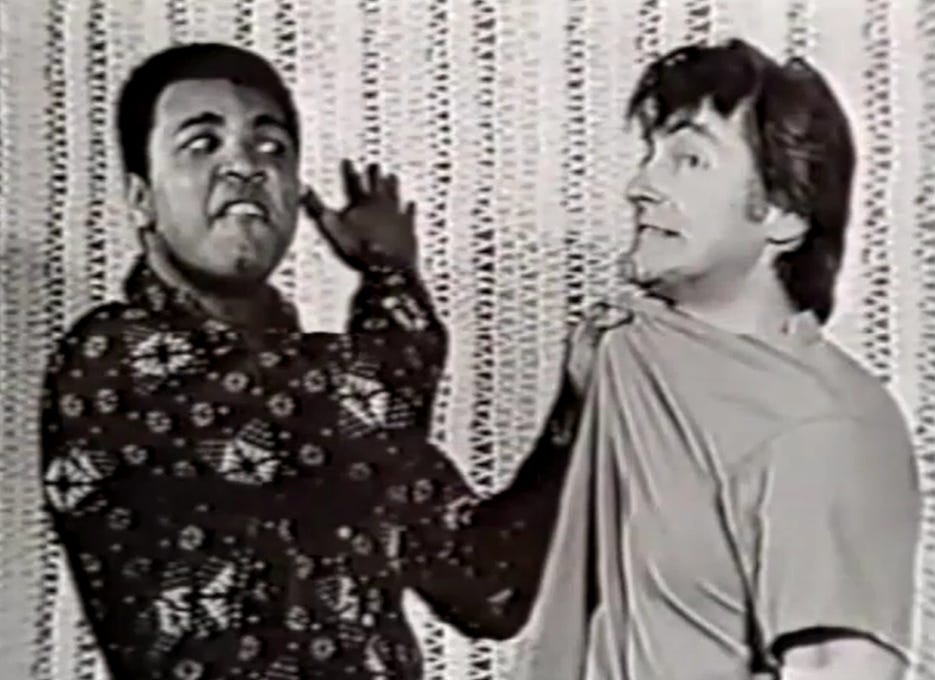
The overall effect—though in moments silly, in moments tender, in moments endearingly clumsy, and, of course, in moments cinema of the quality of Return of the Fly—is another demonstration that Cleveland matters.
“You look as if you’ve just seen a ghost, old man,” says Philippe’s friend Alan Hinds (David Frankham) when Philippe’s trauma over the loss of his father is triggered by a common housefly…
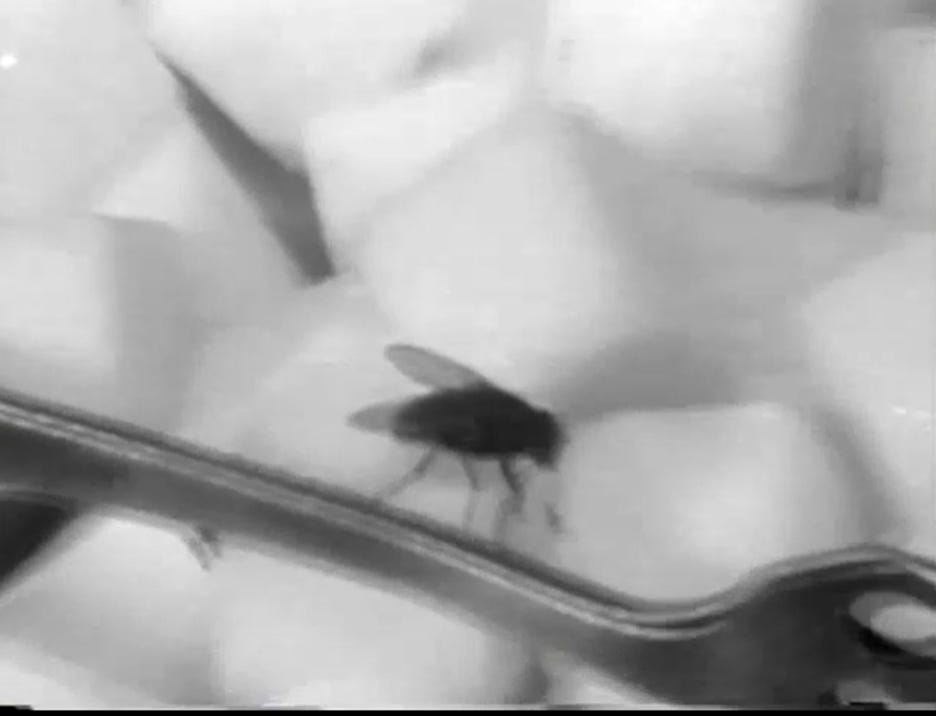
…a fly no doubt not anatomically unlike the one that fused with the elder Delambre in the previous film.

Friend Alan Hinds turns out to be Ronald Holmes, a wanted criminal engaged in an industrial espionage scheme to steal the “disintegrator-integrator” that is Philippe’s, Philippe’s dead father’s, and soon, though reluctantly, Philippe’s uncle’s (Vincent Price) ongoing project; and Holmes eventually kills, using the teleporter to hide his crimes, consequently fusing his human victim’s corpse with the body of a mouse…
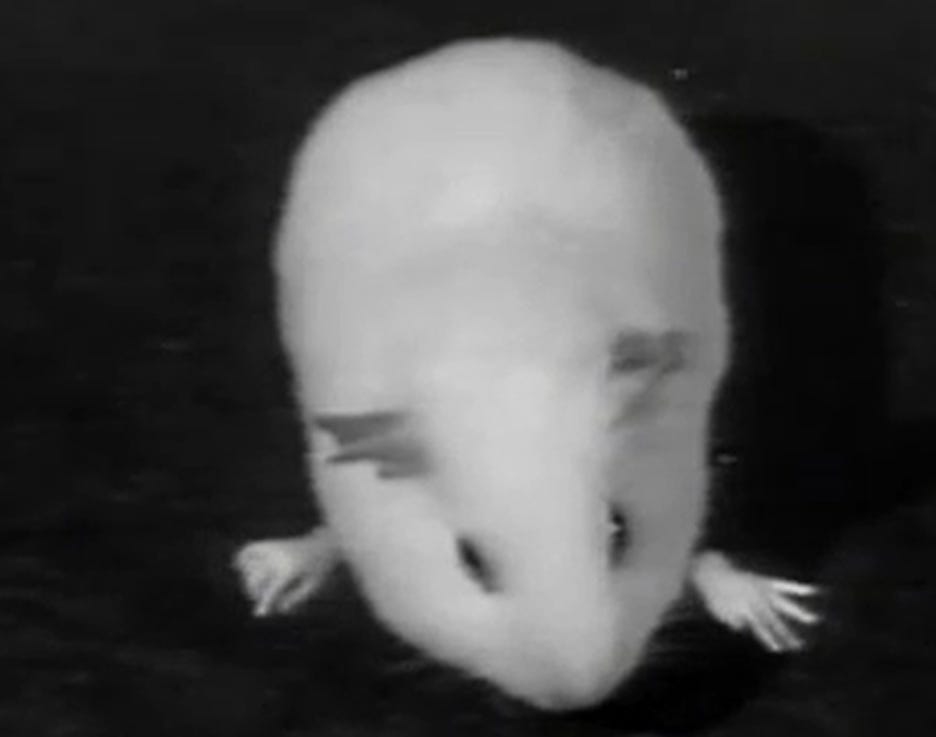
…and in the process generally making clear why David Cronenberg was drawn to these surrealistically freaky films.
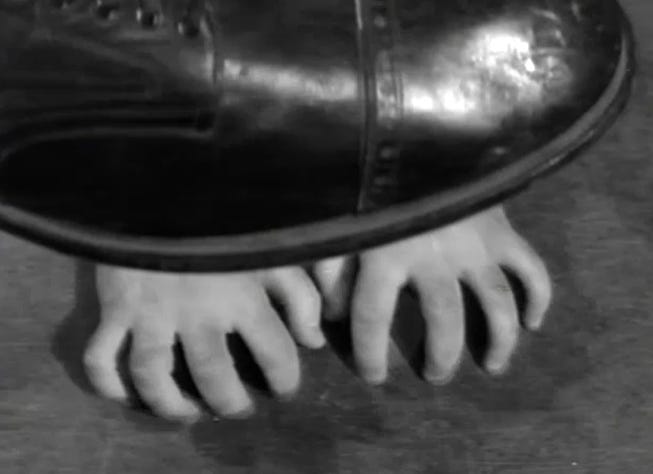
Then, in the spirit of abrupt shifts in mood, the film’s vintage sci-fi lunacy is juxtaposed by Chuck and Hoolihan with an also vintage show sketch of a man in a pizza-eating contest with a dog.
It perhaps goes without repeating that Hoolihan and Big Chuck’s bizarre mash-up of horror film and local color exists to provide “content” on the affiliate beyond the primetime hours.
And popular culture scholars in the Ghoulardi documentary Turn Blue note that one of the side effects of these local sketch shows is the creation of a common body of cultural literacy shared between, on one hand, kids of the sixties, seventies, and eighties and, on the other, their parents and grandparents, elder media consumers who grew up watching these horror films, The Three Stooges, and Hal Roach movies in theaters.
These are important critical observations, as is the point that, sans framing by the Cleveland sketch show, Return of the Fly is deliriously insane genre cinema.
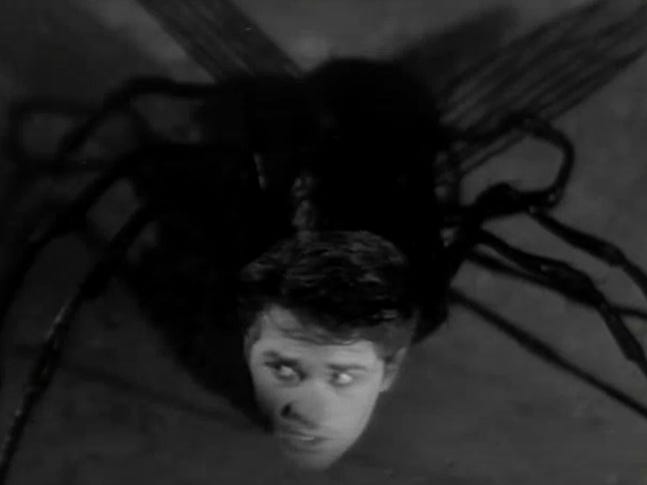
But the aforementioned implication of Ghoulardi, The Hoolihan and Big Chuck Show, and The Big Chuck & Lil’ John Show—i.e., that these shows collectively demonstrate Cleveland matters—interests me most here, particularly to whatever degree the more affective qualities of a “show” like the one I have been describing merit consideration.
In the posthumous Harvey Pekar’s Cleveland (script: Harvey Pekar; art: Joseph Remnant, 2012), author/narrator Pekar discusses Ghoulardi alongside Alan Freed and The Rock ‘n’ Roll Hall of Fame.
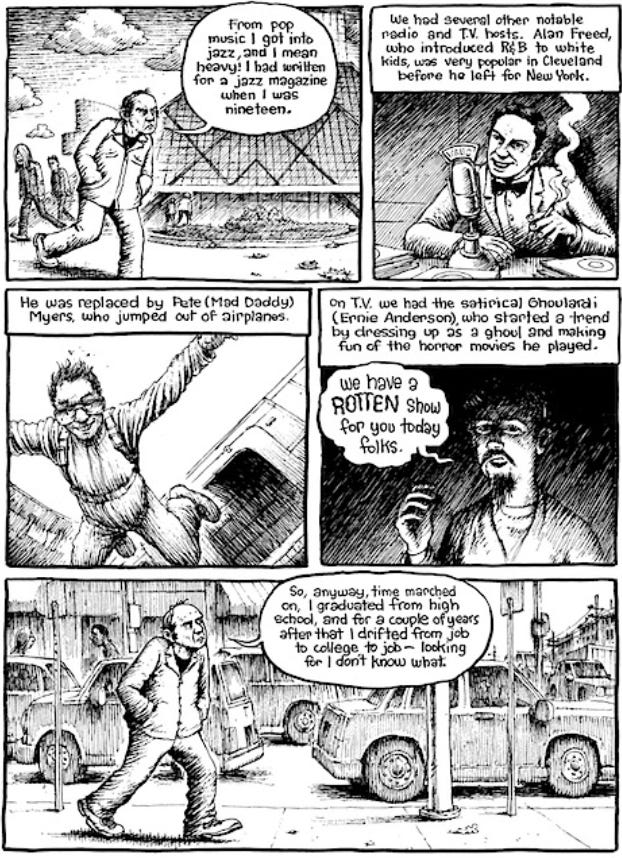
It is fitting that Pekar should remember Ernie Anderson’s alter ego not only as part of Cleveland’s history but also, like Pekar himself, as a Cleveland auteur.
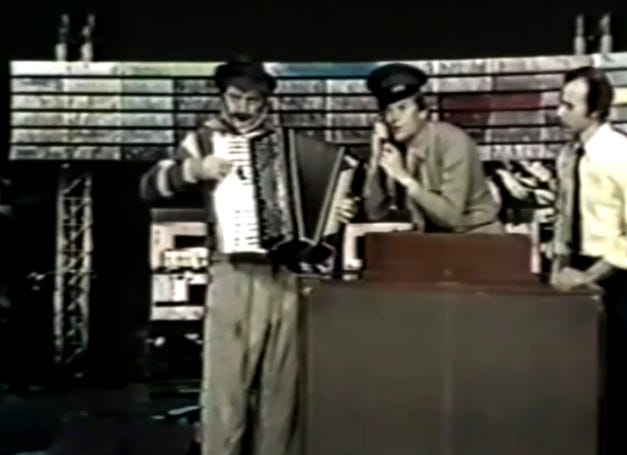
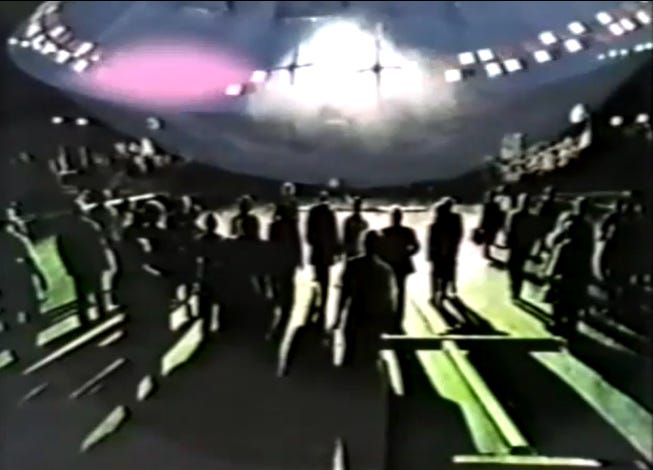
Elsewhere in Pekar and Remnant’s graphic novel, Pekar tells an aspiring Cleveland artist that it is difficult to ever be successful if you are not from a “media city”; and a sketch from the Bob Wells send-off special similarly self-deprecates via send-up of (Cincinnati-born) Steven Spielberg’s Close Encounters of the Third Kind (1977), a spoof wherein scientists discover that extra-terrestrials respond best to Polish Clevelander Stash Kowalski’s accordion,
with the aliens offering their own polka light show in return.
As self-deprecation goes, this sketch is also frankly…
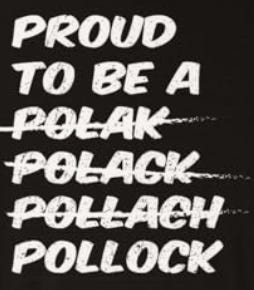
…which my Polish-Lithuanian father had written on a t-shirt he wore while sitting and drinking Strohs at the Wayne County Fair, where, three years prior to the Hoolihan send-off special, my dad won a bicentennial brass spittoon in a tobacco-spitting contest.
I did not grow up in Cleveland but rather on a small farm in Ohio’s northwesternmost Appalachian county, which at the time boasted the world’s largest population of Amish. Not being Amish (but rather Polish-American, French, Lithuanian, Scots-Irish), my family had an antenna jammed in the ground beside our farmhouse, and that antenna was aimed at Cleveland. For more than a decade growing up I was a regular late-night consumer of, first, The Hoolihan and Big Chuck Show and, more consistently, because I was older then, The Big Chuck & Lil’ John Show.
As noted by Phil Hoffman’s documentary, these shows allowed kids my age to experience movies like House of Usher (Roger Corman, 1960) and The Abominable Dr. Phibes (Robert Fuest, 1971) as if these films, like Stash Kowalski, were simply part of the contemporary northeastern Ohio landscape. Chuck Schodowski and John Ranaldi, along with members of the Cleveland Browns, would attend Rubbermaid United Way charity events in nearby Wooster, and the culture of local celebrity was an integral part of the feeling of regional community that could unite a geographic area encompassing Midwestern, Appalachian, and Rust Belt cultures (African American, Jewish, German, Italian, Eastern European, Scots-Irish, Indigenous, Asian, Latinx, Swiss Anabaptist), and, less temporally directly, is part of a history extending from TV postmodernity back through the settler colonialist and Indigenous histories of a corner of “The Northwest Territory.”
If you are wondering if you will enjoy a 1979 Hoolihan and Big Chuck Show screening of the 1959 sequel Return of the Fly in the same way that I or my friend Curtis Meade might, I would say that it is unlikely.
But Chrissie Hynde (Akron)?
Jim Jarmusch (Cuyahoga Falls)"?
Luke Perry (Mansfield), before his unfortunate passing in 2019?
Yeah, they might.